
Platform concepts and data flow
Use this reference when deciding which resource to create. A connection, a managed data copy, a business model, executable logic, and a user interface are separate parts of a workflow.
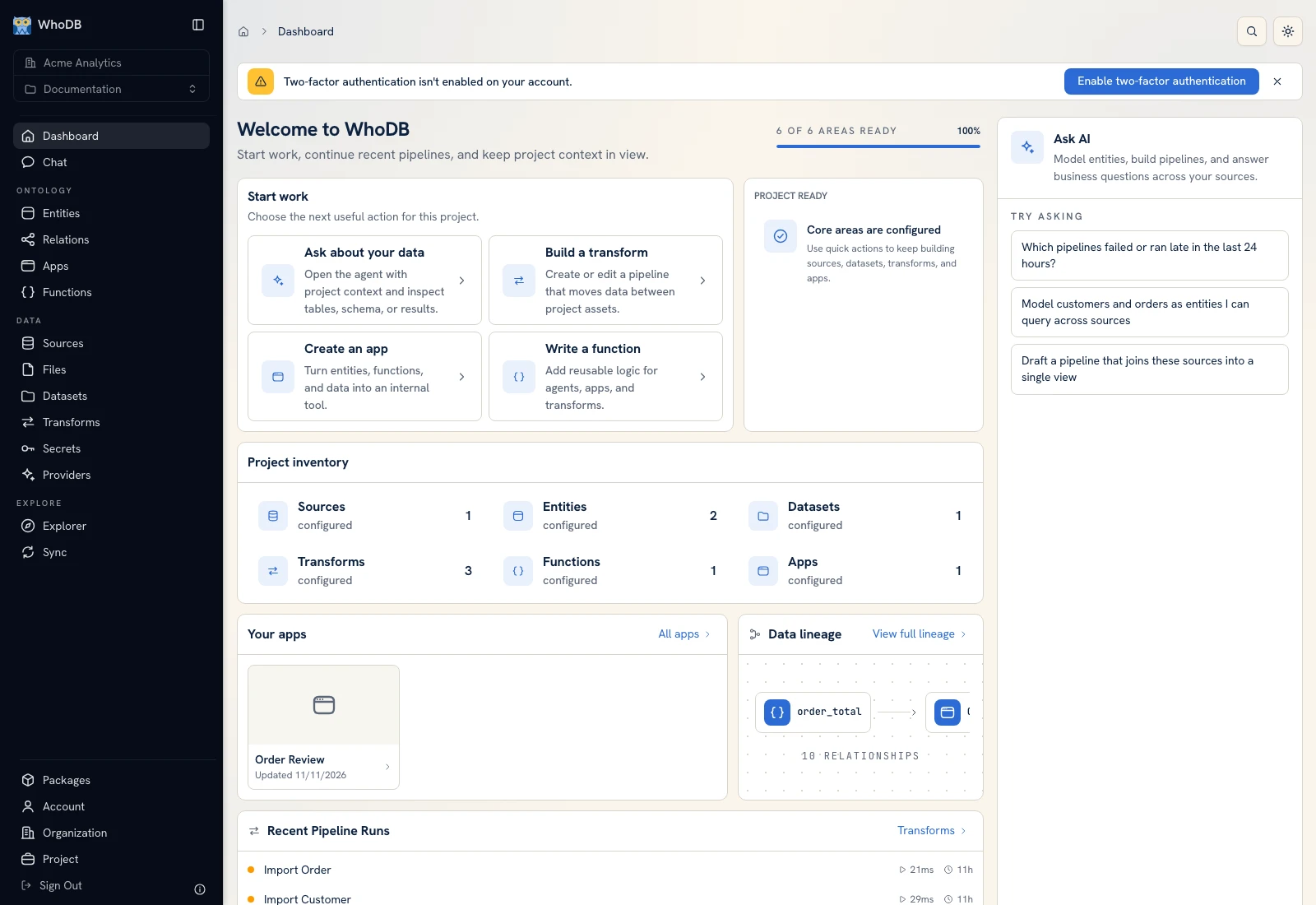 The inventory exposes each resource area without implying that creation in one automatically configures the others.
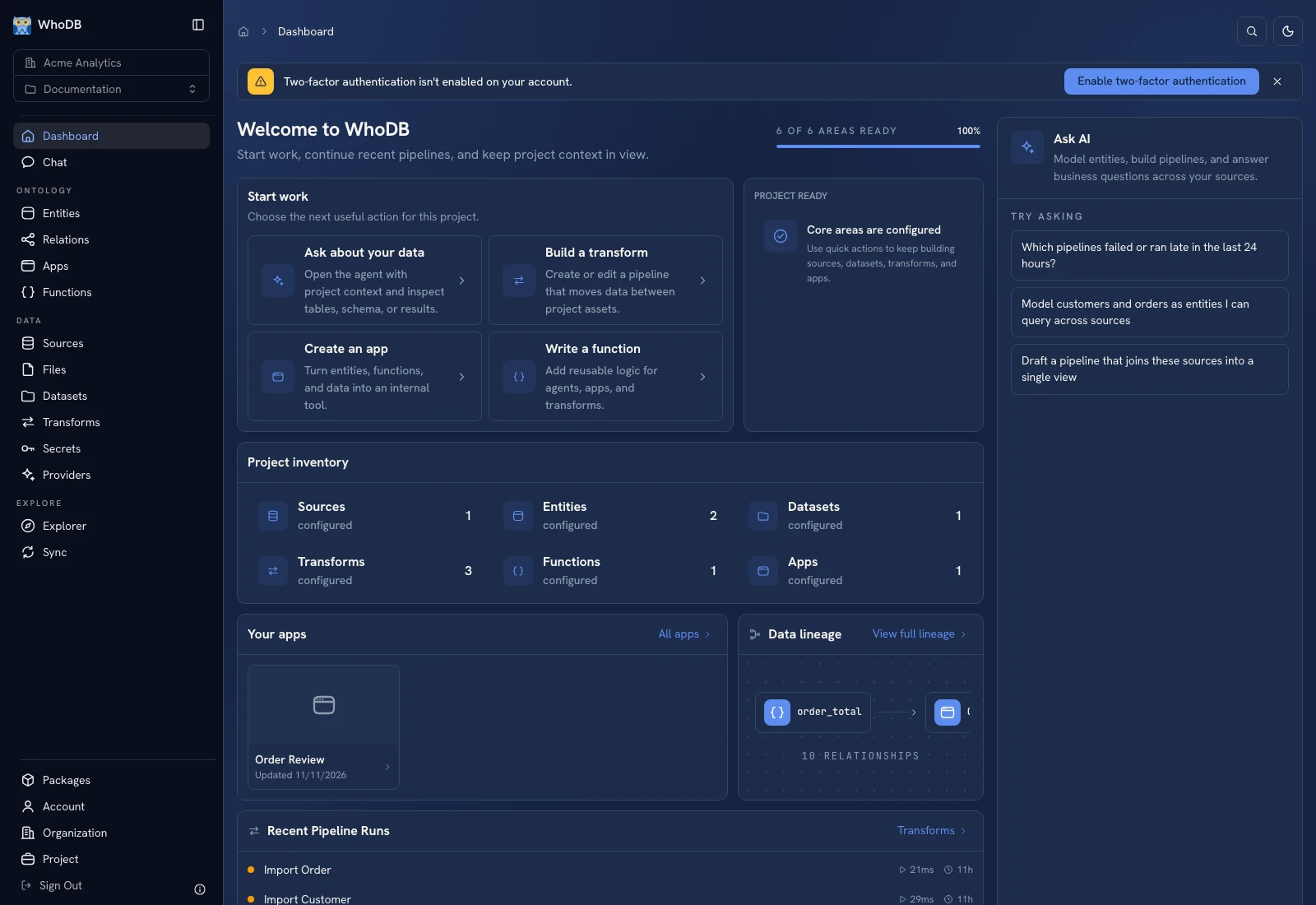 The inventory exposes each resource area without implying that creation in one automatically configures the others.
| Resource | Owns or describes | Does not establish by itself |
|---|---|---|
| Organization | Team/admin context | Access to every private child resource |
| Project | Workspace for related resources | A copy of another project's content |
| Source | External connection configuration | A managed copy of all external rows |
| File | Uploaded content | A dataset/entity or recurring refresh |
| Dataset | Stored records/schema configuration | A recurring data movement schedule |
| Entity | Managed business records, properties, key, and links | Automatic live binding to an external source table |
| Relation | Configured business-key connection | Clean data or an external database constraint |
| Transform | Read/process/write graph | Correctness without a completed run and result check |
| Function | Code, runtime, and bindings | Caller permission or access to every credential |
| App | Pages, state, bindings, and actions | A published active version visible to every teammate |
| Secret | Stored credential value | A consumer grant or alias binding |
| Provider | AI/lineage service configuration | Current runtime availability or correct model output |
| Package | Frozen versions and dependency requirements | Activation of every installed resource |
Follow the handoffs#
For external Orders, connect Source → inspect table → create managed Order → configure/import with Transform → verify managed rows → bind to App/Function. Keep the external business key as a property such as external_id while the managed record retains UUID identity.
A file can instead become a dataset through promotion, then feed a transform or another workflow. Refresh behavior must be configured explicitly; the name “source” or “dataset” does not imply continuous replication.
Three scopes to check#
Check the organization/project, the caller's resource access, and the draft/active version. Many apparent data bugs are a mismatch in one of those contexts. Use the Orders tutorial for a complete example with known counts and keys.
Was this page helpful?